Making Bharat Aatmanirbhar with limitless energy.
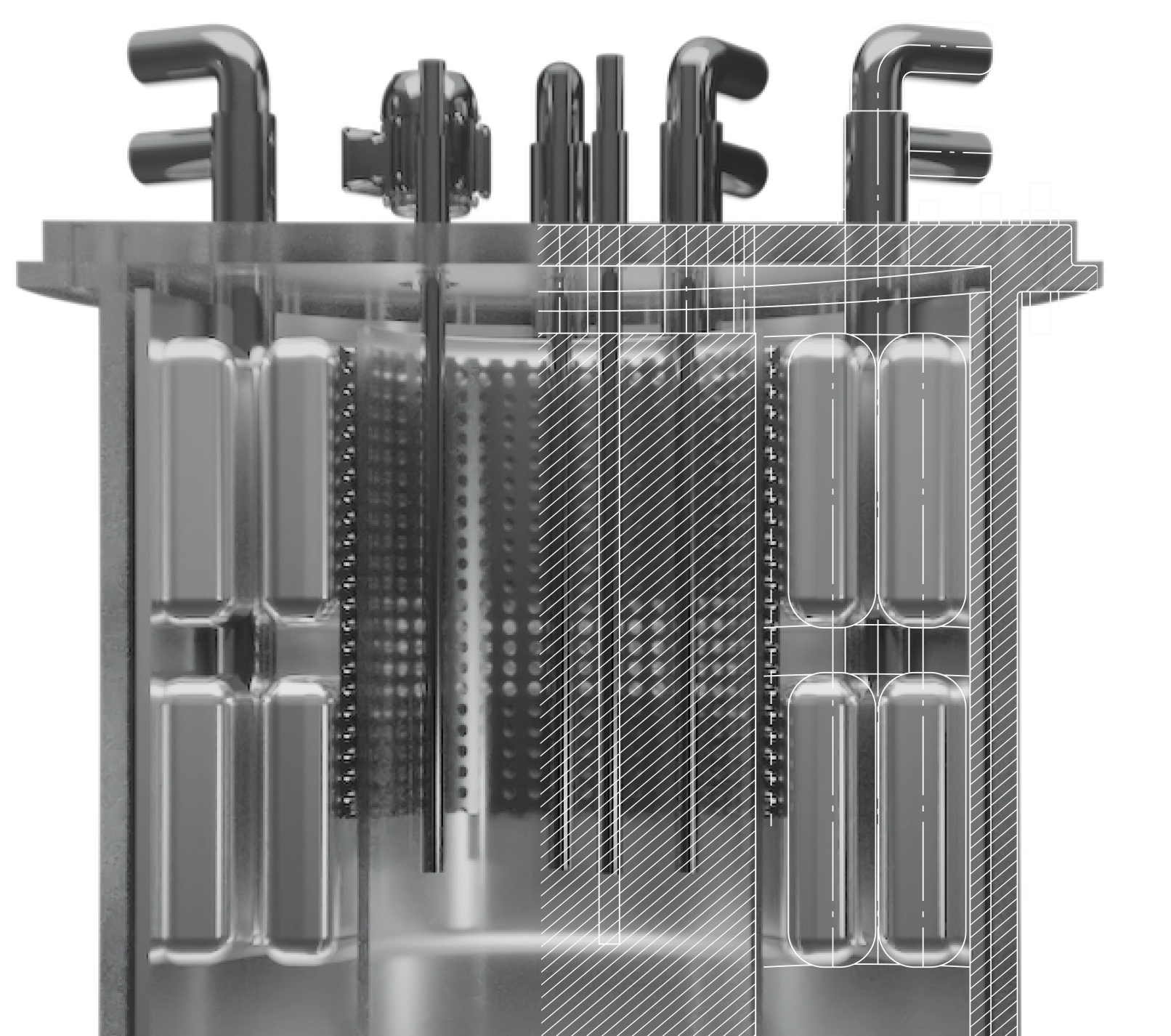
We are developing the most affordable
sodium-cooled fast reactor that runs for twenty years on a single fuel load, and can be factory-built and deployed anywhere in India.

Designed to accelerate Bharat’s three-stage nuclear program, starting now.
The advanced fast reactor is the bridge between Bharat's uranium present and a thorium-powered future.
We are building that bridge early, keeping the momentum and building it right.
Dictated by strategic early decisions to realise the promise made to Bharat.
Advanced fast spectrum reactor
Built on the technical depth and expertise of over a decade in advanced fast reactor design, fuel systems, technology and safety analysis, to build it right.
A core that runs for 20 years
A unique single-batch reactor core that operates for twenty years without refuelling. This makes it deployable even in grid-isolated regions, remote sites, and requires less maintenance.
Liquid sodium as the coolant
Liquid sodium transfers heat from the reactor at near-atmospheric pressure. It also allows the reactor to cool naturally in the absence of active systems.
A decade of advanced nuclear expertise.
Paired with a decade of experience turning deep technology into a deployable product.
[Chirayu Batra]
[Co-Founder]
IIT Roorkee Graduate (2008) and former IAEA reactor physicist and global expert in fast reactors and SMRs, with deep experience in advanced reactor designs (SMRs), safety, and commercialization.
[Sumit gupta]
[Co-Founder]
IIT Bombay Graduate (2014) and Co-founder of CoinDCX, who built India’s 1st crypto unicorn and now a $2.45Bn company in one of India's most regulated sectors.
A multipurpose energy source, equipped to meet every demand Bharat could possibly have.
Targeting 150 MWe of firm, clean, and always-on power. Multiple units share site infrastructure, with twin-unit and four-unit configurations in development, reducing cost as capacity scales.
[01]
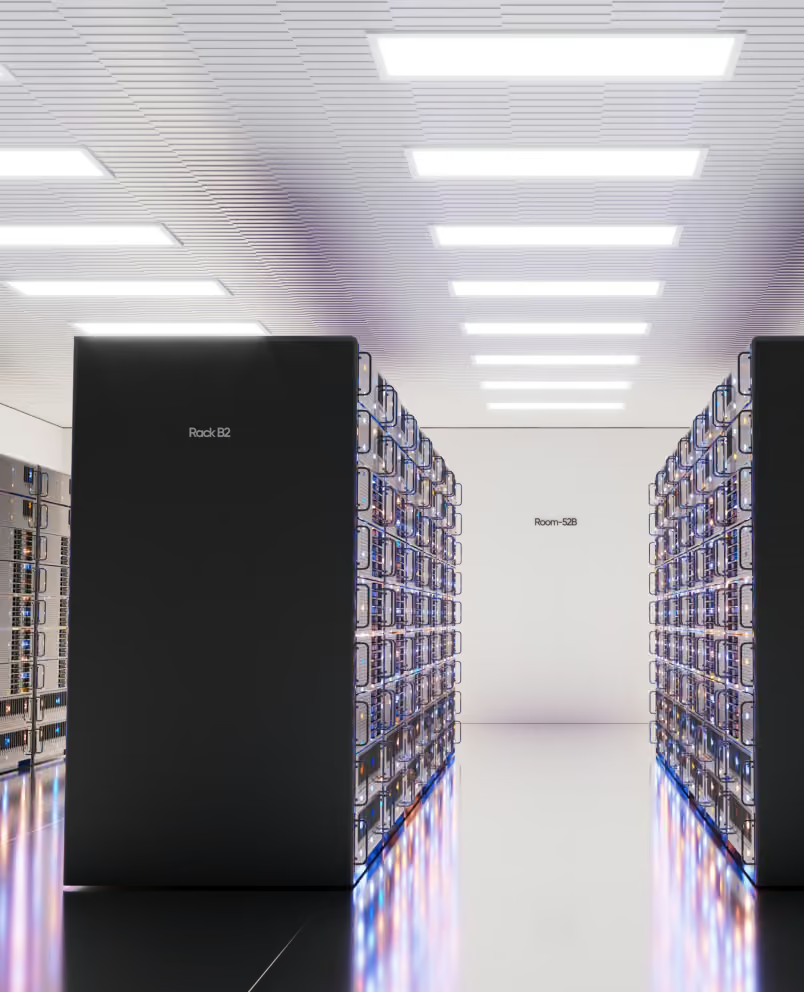
Always-on power for data centres, hyperscalers, and AI infrastructure.
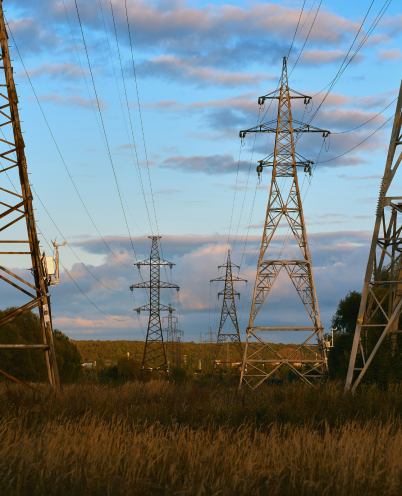
[02]
Baseload electricity for grids, remote communities, and even isolated areas.
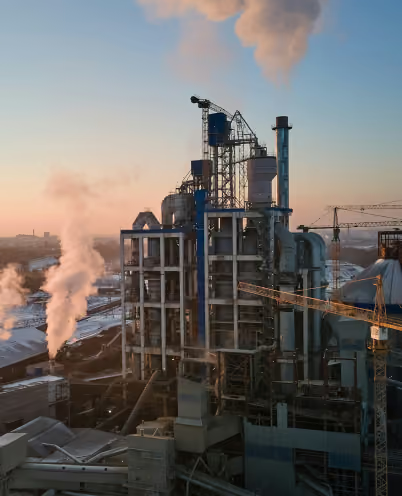
[03]
Process heat and steam at up to 440°C to co-located industrial facilities.
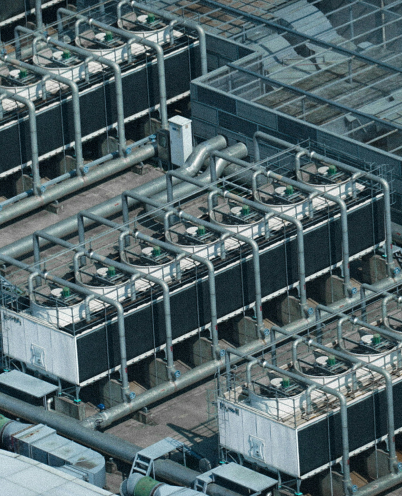
[04]
Clean hydrogen through high-temperature electrolysis.
Towards a resilient future, together.
Collaborations & partnership.
We are making decisions today that will echo for decades. The organisations at this table will have shaped something that outlasts all of us. Bharat is building toward that future, join us to build it together.
Join the team.
We are building something that will exist long after all of us. A small number of exceptional people will be able to say they built it. If your work speaks for itself, you move fast, and you care about what this means for Bharat (India), come pitch what you bring to the table.
FAQs
Yes, and that is the whole bet. Bharat Atomics is treating nuclear power as a product a private company can design, manufacture, and sell repeatedly rather than a one-off government project built from scratch each time. The SHANTI Act changed in December 2025 to make that legally possible in India for the first time.
Not by selling reactors. The company sells electricity under long-term power contracts to customers such as data centres, large-scale manufacturing plants, energy-intensive heavy industries, and so on. Think of it less like selling someone a generator and more like selling them a reliable electricity subscription for 20-40 years.
Because certain customers, like data centres running AI, or factories that cannot afford a single power cut, need power that never flickers, is clean, and is guaranteed for decades. Locking in a long-term price and supply is valuable to them, similar to how a business might sign a long lease instead of renting month-to-month.
Probably, over time. But building a nuclear reactor company is not like entering a typical new market since it takes rare technical talent, years of trust-building with regulators, and serious patient capital before any revenue shows up. The founders are betting that this combination of requirements will naturally keep the field narrow, at least for the first wave of movers.
Very. Nuclear projects have a long history of running late and over budget, and this is a young company trying to be first at something. The founders are upfront that this is not a safe, predictable bet, but it's a long-term, high-conviction wager on a very large possible outcome.
The initial capital goes into proving the design works, running experiments, and engaging with the regulator. Revenue starts coming in only once an actual power plant is built and selling electricity. It's a patient, multi-stage bet rather than a quick-turnaround business.
Their pitch is that this needs two very different strengths at once- someone who deeply understands the technology, and someone who knows how to build a large company in a brand-new, heavily regulated space. One founder has spent his career inside the nuclear industry itself. At the same time, the other has already taken a company from a standing start to national success.
We frame the early customers (large industry, data centres) as the ones who'll pay to fund the first, most expensive plants. The long-term goal, in their telling, is that once the technology matures and gets cheaper, this kind of power becomes affordable and available much more broadly, including to communities that do not currently have reliable electricity.
Building something this complex depends on a long chain of moving parts working together, like securing the right components and materials, getting real-world testing to match what the simulations predict, and having every supplier and partner deliver on time. Even with a strong team and a solid plan, a single delay anywhere in that chain, or a technical result that does not go the way it's expected to, can push timelines.
Success would mean this company is not just one power plant, but a repeatable, factory-built product being deployed again and again across India (and eventually exported), rather than each plant being hand-built from scratch. The founders' vision is to be one of the companies that defines a new, more energy-independent era for India- not just delivering a single successful project.